
OIG exclusion screening is the routine check of the HHS Office of Inspector General's List of Excluded Individuals/Entities (LEIE) and related sanction lists to confirm that no one on your payroll or vendor roster is barred from federal health care programs. The required action is straightforward: check every prospective hire against the LEIE before their first day, then recheck your full staff and contractor list every month.
TL;DR:
- Screen nonclinical staff, owners, agents, and contractors’ employees whose work affects care, billing, or claims; outsourcing does not transfer your practice’s liability.
- Bulk LEIE matches lack SSNs and EINs, so verify each potential hit in the searchable database before acting; state Medicaid lists can reveal separate exclusions.
- Keep dated search records naming the verifier and database version, and require contractors to provide reports identifying the people screened and check dates.
- If a match is confirmed, remove the person from federally payable work, assess affected claims, and determine whether the OIG disclosure protocol applies.
- An exclusion does not end automatically when its stated term passes; require formal OIG reinstatement notice, and verify federal and state status separately.
Table of Contents
- What the OIG exclusion is and why it matters
- Who you actually need to screen
- Where to check: LEIE, SAM.gov, and state lists
- How often you need to screen and where that requirement comes from
- Verification, matching, and documentation that hold up
- What to do if you find an excluded person
- Reinstatement and why exclusions do not just expire
- A practical checklist and your 72-hour audit-readiness plan
- Training your team on exclusion screening
- Coordinating screening with compliance and credentialing
- Fitting exclusion screening into your existing workflow
- Automating exclusion screening for ongoing coverage
- Where screening fits among your bigger compliance priorities in 2026
- How HIMShield supports your exclusion screening and audit readiness
- FAQ
- Sources
What the OIG exclusion is and why it matters
When the Office of Inspector General excludes someone, it bars that person or entity from participating in any federal health care program, including Medicare and Medicaid, under authority granted by sections 1128 and 1156 of the Social Security Act. The LEIE exists so providers can check that status before they let an excluded individual anywhere near patient care or billing.
The consequence of missing an exclusion is not a slap on the wrist. Federal law prohibits payment for any item or service furnished, ordered, or prescribed by an excluded individual, and that prohibition applies no matter how the claim gets billed, whether directly or bundled into another provider's claim.
- Payment for excluded-person services can trigger civil monetary penalties.
- Overpayment liability attaches even when the exclusion was missed unintentionally.
- Liability extends to anyone who employs or contracts with an excluded party, not just the excluded person.
The OIG's LEIE is the authoritative source for exclusion status, offering more detail on OIG actions, including the statutory basis and occupation at time of exclusion, than any other public database. That level of detail is exactly what you need when a name match turns up and you have to decide fast whether it is really your employee.
Who you actually need to screen
Practices often screen clinicians and stop there, which leaves real exposure on the table. OIG's guidance on exclusion effect points to a broader population, and the test is simple: could this role touch patient care, billing, or claims submission in any way?
- Employees and prospective hires, clinical and nonclinical alike (front desk staff, billers, and schedulers count).
- Owners, officers, managing employees, and agents of the practice.
- Contractors and subcontractors, including staffing agency placements and billing vendors.
- Employees of any contractor whose work touches services payable by a federal health program.
That last category trips up more practices than any other. Hiring a billing company does not transfer the screening obligation away from you, and if that company's own staff member turns out to be excluded, your practice still carries the liability. The practical rule: if a role can influence a diagnosis, a treatment decision, a chart note, or a claim, it goes on your screening list.
Where to check: LEIE, SAM.gov, and state lists
Screening correctly means knowing which database answers which question, because no single list covers everything.
- The LEIE online searchable database lets you verify a specific person using their Social Security number or Employer Identification Number, which is the gold standard for confirming a match.
- The downloadable LEIE file supports bulk matching against your full roster but omits SSNs and EINs due to Privacy Act restrictions, so a hit there is a starting point, not a confirmation.
- Sam cover debarments and suspensions issued by federal agencies beyond OIG, useful for contractor vetting, though OIG exclusions themselves are documented in far more detail directly in the LEIE.
- State Medicaid exclusion lists matter too, since a person can be excluded at the state level without yet appearing on the federal LEIE, and many state contracts require checking both.
Pro Tip: Run your bulk match against the downloadable LEIE first, then confirm every potential hit using SSN or EIN in the online searchable database before you act on it.
How often you need to screen and where that requirement comes from
The screening cadence is not arbitrary. OIG updates the LEIE monthly, typically by the 10th of each month, and its own Special Advisory Bulletin on exclusion effect recommends screening prior to hiring and periodically afterward. CMS guidance to state Medicaid directors has similarly recommended that states require monthly checks, and many state contracts now build that expectation directly into provider agreements.
A workable schedule looks like this:
- Pre-hire check for every candidate before an offer is extended.
- Onboarding check again just before the start date, since status can change in the gap.
- Monthly recheck of your entire active roster, timed after the LEIE's monthly update.
- Event-triggered recheck whenever you add a new contractor, renew a vendor agreement, or get a tip about a specific individual.
Monthly is not a suggestion dressed up as a best practice. It is the cadence that matches how often the underlying data actually changes.
Verification, matching, and documentation that hold up
A name match is not proof of exclusion, and treating it as one creates its own set of problems, from wrongly sidelining an employee to missing a real match because you assumed it was a coincidence. The LEIE Quick Tips & Instructions lay out the correct sequence: use the downloadable file for mass matching, then verify any hit with SSN or EIN in the online database before taking action.
- Check former and maiden names, hyphenated last names, and date of birth, since common names generate false positives regularly.
- Cross-reference NPI or EIN where available to add another layer of confidence to the match.
- Record exactly which database version you searched, the date, and who performed the check.
- Keep printed or archived search results as your evidence, not just a verbal confirmation that "someone checked."
Contractor screening deserves the same rigor. A contractor's assurance that they screen their own staff is not evidence; you need a report naming the specific individuals checked and the dates of those checks. Treat that documentation request as a standard part of every vendor agreement.
Pro Tip: Store screening evidence the same way every time: screenshot or printout, verifier name, date, and database version, so an auditor can reconstruct your process in minutes rather than hours.
What to do if you find an excluded person
Finding an excluded person on your roster is uncomfortable but manageable if you move fast and document everything.
- Remove the individual immediately from any duties connected to federally payable services.
- Quantify the claims potentially affected during the period the person was excluded and working.
- Evaluate whether the OIG Self-Disclosure Protocol applies to your situation, and notify affected payers as your contracts require.
- Document every corrective step, the timeline, and all communications with payers or OIG.
The overpayment exposure from those affected claims often exceeds the cost of catching the issue early, which is the entire argument for monthly screening in the first place. Practices that document their response thoroughly tend to fare far better in any follow-up review than those that scramble to reconstruct a timeline after the fact.
Reinstatement and why exclusions do not just expire
One of the most common mistakes we see is assuming an exclusion ends on its own once a stated term passes. It does not. OIG's reinstatement guidance is explicit that reinstatement requires a formal application to OIG and a formal notice of reinstatement before an individual or entity can participate in federal programs again.
- Never treat a passed exclusion term as automatic clearance; check the LEIE for an actual reinstatement notice.
- Some exclusions tied to underlying state licensing actions can remain indefinite until the state action itself is resolved.
- State-level reinstatement and federal reinstatement are separate processes, and one does not automatically trigger the other.
When in doubt, search the LEIE directly for the individual's current status rather than relying on a remembered exclusion date.
A practical checklist and your 72-hour audit-readiness plan
Screening only protects you if it is documented well enough to survive a payer audit. Build a short, repeatable checklist your team actually follows:
- Assign one named owner responsible for screening, not a shared or unassigned task.
- Run pre-hire and onboarding checks before anyone touches a chart or a claim.
- Schedule monthly rechecks tied to the LEIE's update cycle.
- Retain documentation on a fixed schedule, not just when someone remembers.
- Validate contractor screening with their actual records, not their word.
- Define an escalation path for when a match is confirmed.
If an audit notice lands, the first 72 hours matter most. Pull your verification records, gather the last several months of screening logs, identify any claims tied to at-risk individuals, and assemble a clear summary of your findings. Our own analysis of practices facing OIG audits found that gaps in documentation, not the underlying error itself, are usually what turns a routine inquiry into a drawn-out one. A structured 72-hour response built around existing records, rather than a scramble to create them, is what separates a quick resolution from a prolonged one.
Training your team on exclusion screening
A screening process only works as well as the people running it. New hires in your compliance or HR function need a clear, written procedure: which database to check first, how to verify a match, and where to log the result. Without that, screening quality depends entirely on who happens to be doing it that month.
Build training around three things: the actual mechanics of searching the LEIE and verifying with SSN or EIN, the documentation standard your practice expects every time, and the escalation path for a confirmed match. A short written procedure beats a one-time verbal walkthrough, because staff turnover means someone new will eventually inherit this responsibility with no memory of the original training.

Refresh training annually at minimum, and whenever OIG updates its guidance or your practice changes its vendor relationships. Include front-office and HR staff who handle contractor paperwork, not just the person who runs the monthly LEIE search, since a contractor's screening gap is just as much your liability as an employee's.
Credential verification often overlaps with exclusion screening, and your training should draw that line clearly for staff. For nursing staff specifically, confirming license status through a source like Nursys verification is a separate but related check worth including in the same onboarding packet, since license status and exclusion status can diverge.
Coordinating screening with compliance and credentialing
Exclusion screening rarely sits in isolation. It overlaps directly with credentialing, license verification, and your broader compliance program, and treating it as a separate silo creates duplicate work and gaps.
When your credentialing team verifies a new provider's license and board certification, that is the natural moment to also run the LEIE check, rather than routing it through a different department on a different timeline. The same applies to recredentialing cycles: if your practice recredentials providers every two or three years, build a monthly exclusion check into that cycle rather than waiting for the recredentialing date to roll around.
Vendor and contractor management should follow the same logic. Whoever signs off on a new billing vendor or staffing agency contract should require exclusion screening documentation as a condition of that agreement, the same way they would require proof of insurance or a signed business associate agreement. Coordinating these checkpoints means exclusion status gets reviewed at every point where it would otherwise be easy to miss: new hire, new contract, and routine recredentialing.
Fitting exclusion screening into your existing workflow
The practices that keep up with screening long-term are the ones that build it into steps they already perform, rather than treating it as an extra task bolted onto a busy month.
Tie your pre-hire check to the same workflow as your background check and reference calls, so a new hire cannot start without both clearing. Tie your monthly recheck to a fixed date right after the LEIE's monthly update, such as the 12th or 15th of each month, and put it on the same calendar as payroll or other recurring compliance tasks you never skip.
For contractors, build the screening requirement into your vendor onboarding checklist alongside your standard contract review, so it never depends on someone remembering to ask separately. The goal is a workflow where exclusion screening happens automatically as a byproduct of steps you already take, not a standalone to-do list that competes for attention with patient care and billing.
Automating exclusion screening for ongoing coverage
Manual LEIE searches work for a small roster, but they get harder to sustain as your staff and vendor list grows, and a missed month is exactly when risk tends to show up. Automated screening tools solve the core problem: they run the monthly comparison against the LEIE and other sanction lists without relying on someone remembering to do it by hand.
A good automated approach still follows the same verification principle OIG recommends: a bulk match flags potential hits, and a verification step confirms them against SSN or EIN before anyone acts. The value of automation is consistency and documentation, not skipping steps that protect you from false positives.
Look for a tool that timestamps every search, retains historical results for your audit trail, and flags a confirmed match clearly enough that your designated owner can act within days, not weeks. That documentation trail is often what separates a practice that sails through a payer audit from one that spends weeks reconstructing six months of screening history from memory.

Where screening fits among your bigger compliance priorities in 2026
If I had to rank compliance tasks by return on effort, monthly exclusion screening with preserved documentation sits near the top. It is cheap to do consistently and expensive to skip, and the audits we see rarely fail because a practice never screened, they fail because the screening happened without a usable paper trail behind it.
Fold the check into onboarding and vendor contracts rather than running it as a separate initiative. Small practices without compliance departments can scale this with a simple calendar reminder and a documented process, no large budget required, as long as someone owns it every single month.
— Elena
How HIMShield supports your exclusion screening and audit readiness
We built our platform to take the manual grind out of ongoing compliance work for physician practices, and exclusion screening documentation is part of that picture. Our automated monitoring flags coding, documentation, and charge-capture risks before they become denials, applying an evidence-first approach to the records needed when a payer or OIG comes asking questions.
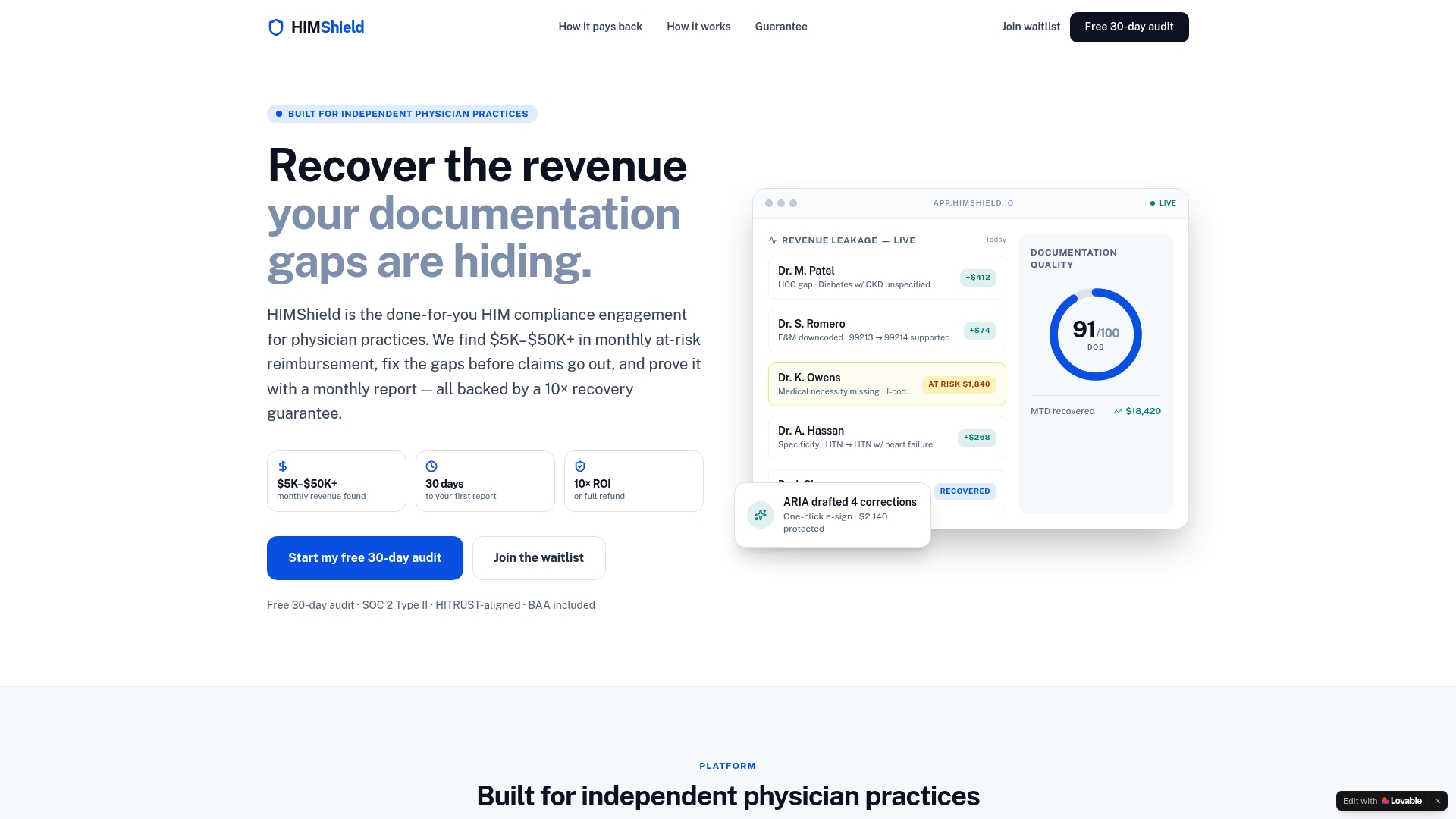
- Automated alerts that keep your compliance documentation current without manual chasing.
- Audit-ready reports assembled from claims and documentation history.
- A free, no-obligation 30-day Revenue Leakage Audit that shows you exactly where your gaps sit before you commit to anything.
If your practice is ready for ongoing compliance support built around your own data, our free audit is the lowest-effort way to see where you stand right now.
This article is general information, not a substitute for advice from a qualified lawyer. Consult a qualified legal professional about your own circumstances before acting on anything here.
FAQ
What is OIG exclusion screening?
OIG exclusion screening is the process of checking employees, contractors, and owners against the LEIE and related sanction lists to confirm none of them are barred from federal health care programs. It protects your practice from billing for services tied to an excluded individual, which federal law prohibits outright.
How often do you have to check the OIG exclusion list?
OIG updates the LEIE monthly, so screening your full staff and contractor roster every month is the standard practices follow to stay current. Pre-hire and onboarding checks should happen in addition to that monthly cycle, not instead of it.
Who is on the OIG exclusion list?
The LEIE lists individuals and entities OIG has excluded from federal health care programs, including people convicted of health care fraud, patient abuse, or controlled substance offenses, among other grounds. Each entry includes the statutory basis for exclusion and the person's occupation at the time.
What are the mandatory exclusions OIG is required to exclude?
Mandatory exclusions apply to convictions for offenses like Medicare or Medicaid fraud, patient abuse or neglect, and felony convictions related to controlled substances, as outlined under OIG's statutory authority. These exclusions are not discretionary; OIG must impose them once the underlying conviction is established, as described in the Special Advisory Bulletin on exclusion effect.
Is reinstatement automatic once an exclusion period ends?
No. OIG's reinstatement process requires a formal application and a formal notice of reinstatement before an excluded individual can participate in federal programs again, regardless of how much time has passed.
Sources
- Exclusions Program | Office of Inspector General
- State Medicaid Director Letter (CMS) - screening guidance