
Audit risk scoring is a numeric measure of coding accuracy, documentation quality, and charge-capture completeness that tells you which charts, providers, and payers carry the highest risk of denial or audit. The score's job is simple: rank your risk so you fix the worst problems first. Practices that build one usually watch three signals closely: coding accuracy, documentation defensibility, and missed charge rate.
TL;DR:
- An audit risk score combines metrics like coding accuracy, documentation quality, missed charges, payer signals, and risk adjustment support for comprehensive assessment.
- Immediate actions for high-risk charts include chart review and claims hold, while medium and low risks are managed through focused queries and periodic sampling.
- Starting with a 60 to 90-day pilot involving designated roles and weekly data review helps embed effective risk management workflows.
- Tracking key KPIs such as first-pass clean claim rate and missed charge rate quarterly confirms the scoring system's effectiveness over time.
Table of Contents
- What Does Audit Risk Scoring Actually Measure?
- How Do You Calculate an Audit Risk Score?
- How Should Practices Act on Risk Scores?
- How Do You Pilot an Audit Risk Scoring Program?
- Which KPIs Prove the Score Is Working?
- How Do You Build an Audit-Ready Evidence Trail?
- Elena's Perspective: The Pitfalls Nobody Warns You About
- Let Himshield Operationalize the Score for You
- Sources
What Does Audit Risk Scoring Actually Measure?
A useful score pulls from five components, each tied to a specific failure mode you can trace back to a real denial.
- Coding accuracy — CPT, ICD-10, and modifier correctness against the encounter. Wrong specificity is the single biggest driver of denials right now: coding errors account for nearly 7 in 10 completed payer-audit denials, according to a recent vendor benchmark from MDaudit.
- Documentation quality (MEAT) — whether notes show the condition was Monitored, Evaluated, Assessed, and Treated at that visit, not just listed from a prior note.
- Missed charges and charge lag — services rendered but never billed, or billed so late they miss timely-filing windows.
- Payer remittance and denial signals — patterns in your remits that flag a recurring documentation or coding gap by CPT code or payer.
- Risk-adjustment support — for practices with Medicare Advantage or ACO panels, whether HCC-relevant conditions have the specificity payers require to hold up on recapture.
Your data sources are the same places you already look during a denial: EHR clinical notes, the charge description master and reconciliation logs, claims and remittance files, encoder output, and prior audit findings. A CKD diagnosis coded without a stage, for example, is a documentation failure that shows up later as an HCC recapture deletion. A procedure performed but never reconciled against the schedule is a charge-capture failure that shows up as lost revenue nobody notices for months.
How Do You Calculate an Audit Risk Score?
Small practices don't need a data warehouse to score risk. Two methods work, depending on your staff and systems.
The lightweight weighted index works for practices without an analytics team. Pick four to six metrics, assign each a weight based on how much it drives denials for your specialty, normalize each to a 0 to 100 scale, and sum the weighted results. A provider scoring 55 on documentation and 90 on coding accuracy still lands in a risk band that needs attention, because the composite, not any single input, drives the triage decision.
The composite multi-source score suits practices with claims analytics or a billing platform that already tracks remits by CARC/RARC code. This version adds payer-specific denial history and query agreement rate to the mix, weighting recent quarters more heavily than older data so the score reflects current behavior, not last year's habits.
Set thresholds conservatively at first. A common structure: scores above 80 are low risk, 60 to 79 are medium, and below 60 trigger immediate review. Build in a grace buffer for new providers or newly onboarded specialties. Scoring a brand-new hire against six months of thin data produces false positives that erode trust in the whole system faster than any coding error will.

How Should Practices Act on Risk Scores?
A score that doesn't change behavior is just a number. The value comes from what happens in the 48 hours after you see it.
- High risk (below 60): Pull the chart for immediate review, issue a same-week provider query, and hold the claim if it hasn't submitted yet.
- Medium risk (60 to 79): Route to a focused CDI query queue with a two-week response window and track the provider's agreement rate.
- Low risk (80 and above): Sample monthly instead of reviewing every chart, and use the freed-up time for recapture work on risk-adjustment codes.
Assign owners by band. High-risk charts belong to a coder or CDI reviewer with a same-day SLA. Medium-risk items go to a queue the billing lead checks weekly. Low-risk monitoring can sit with whoever runs your monthly reconciliation.
Pro Tip: Route high-risk queries with the specific evidence gap already flagged, not a generic "please clarify" note. Providers respond faster and more accurately when the query names exactly what's missing, whether that's a CHF severity indicator or a missing time-based E/M statement.
How Do You Pilot an Audit Risk Scoring Program?

Start small. A 60 to 90 day pilot on one specialty or one high-volume payer gives you clean before-and-after data without overwhelming staff who are already stretched thin.
Roles matter more than tools here:
- A score owner who runs the calculation and owns the thresholds.
- A coder or CDI reviewer who works the high-risk queue.
- A provider liaison who translates findings into query language physicians will actually act on.
- A billing lead who reconciles charge capture against the schedule.
- IT support to automate the data extract from your EHR and billing platform.
The workflow runs on a loop: extract data weekly, score it, hold a short triage meeting to assign the week's high-risk items, then close the loop with remediation and a note back to the score owner on what was fixed. Build your evidence capture, query standards, and documentation edit rules before the pilot starts, not after the first denial lands. A pilot with defined roles and a repeatable cycle, similar to the structure the AMA's STEPS Forward toolkit describes for team documentation, tends to stick once the initial 90 days end.
Which KPIs Prove the Score Is Working?
Track five numbers monthly: missed charge rate, charge lag (days from service to submission), first-pass clean claim rate, denial rate by documentation cause, and RAF/HCC recapture rate where applicable. Add provider query agreement rate to see whether your CDI queries are landing.
Set directional targets, not perfection. A first-pass clean claim rate climbing toward 90% and a missed charge rate falling quarter over quarter both signal the score is doing its job. Review the dashboard monthly, and compare cohorts, this provider against last quarter, this payer against the practice average, rather than chasing a single absolute number that means little without context.
How Do You Build an Audit-Ready Evidence Trail?
Every high-risk finding needs a packet that can leave your office within hours of a payer request, not days.
- Note excerpt showing the specific MEAT language supporting the code billed.
- Encounter date and objective data (labs, vitals, imaging) that corroborate the diagnosis.
- Coder rationale explaining why the code was selected.
- Signed physician addendum when the original note needed clarification after the fact.
Map each piece of evidence to the payer's specific denial reason, using the CARC/RARC code on the remit, rather than sending a generic packet. This is the same approach detailed in sample audit report templates built for auditor reference. Index packets by provider and diagnosis code so retrieval during an active audit takes minutes, not a scramble through shared drives. Practices that treat evidence capture as routine, not reactive, tend to close disputes faster because nothing needs to be reconstructed from memory.
Elena's Perspective: The Pitfalls Nobody Warns You About
The failure mode I see most often isn't a bad formula. It's copy-paste notes that look complete but collapse the moment an auditor compares two encounters side by side. Noisy suspect lists are the second killer. If your high-risk queue has 200 charts on it, nobody works it. Keep the list short enough that someone actually owns it. Quarterly recapture planning and monthly sampling of your highest-volume claim types beat any elaborate scoring formula you could build.
— Elena
Let Himshield Operationalize the Score for You
Himshield turns the scoring framework above into something that runs automatically against your EHR data rather than a spreadsheet someone updates when they remember to. The platform scans coding accuracy, documentation quality, and charge-capture completeness for every provider and payer, then generates a Revenue Leakage Report that shows exactly where dollars are at risk before a claim goes out the door.
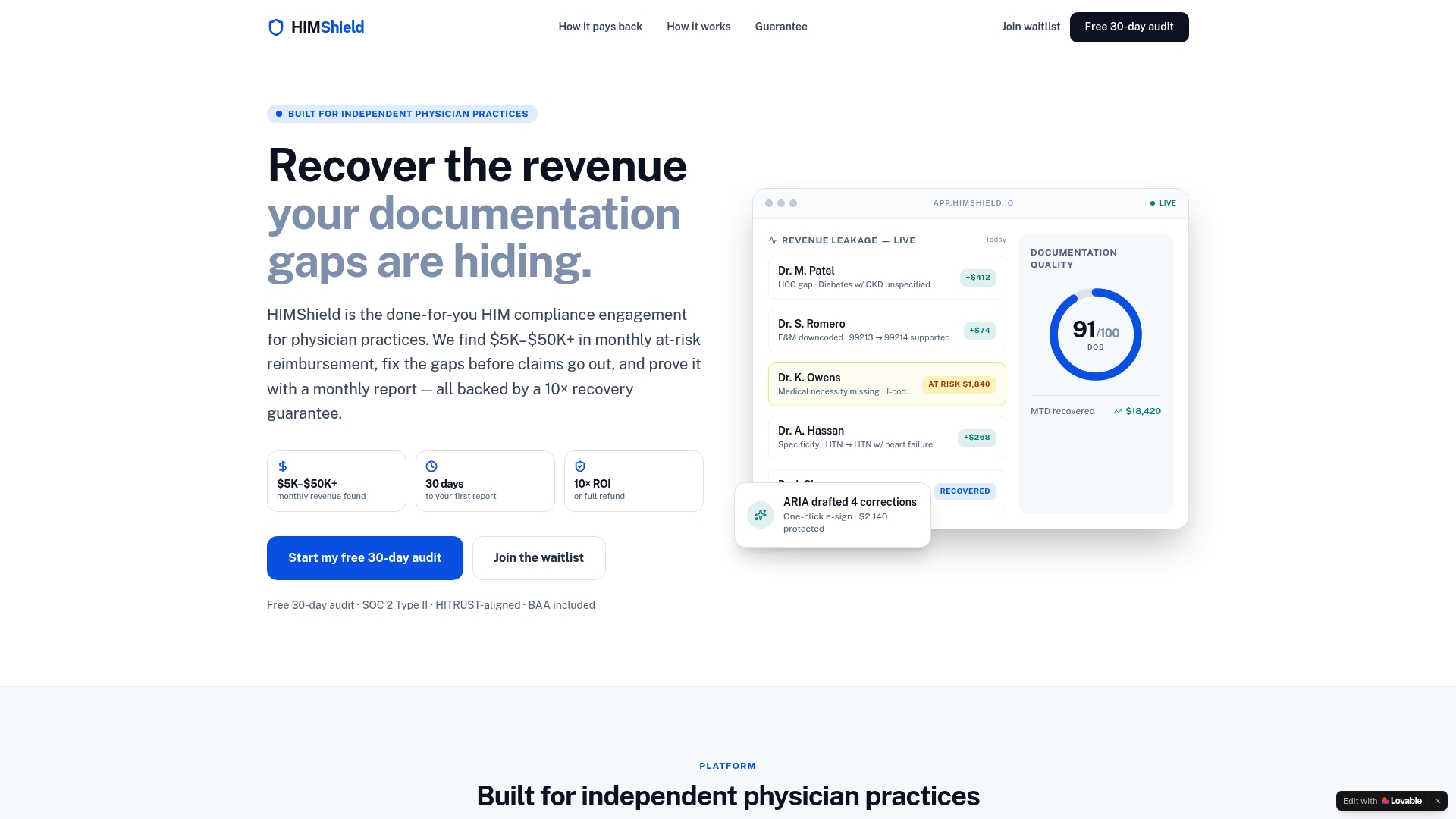
Instead of building the triage queue and dispute packet templates by hand, Himshield auto-drafts corrections with one-click physician e-signature and assembles submission-ready audit responses when a payer comes asking. A free 30-day assessment shows you what your actual risk score looks like across your provider panel, with no build-out required on your end. If you want to see the mechanics first, review how the platform connects to your EHR and recovers revenue within a month. Otherwise, start the 30-day audit at Himshield and see your first Revenue Leakage Report before your next payer audit request lands.
Sources
- Team Documentation: Improve Efficiency of EHR Documentation — AMA STEPS Forward
- Coding errors now drive nearly 7 in 10 completed payer-audit denials, MDaudit | HCC Buddy