
A coding compliance officer makes sure clinical documentation supports every code billed, and that the resulting claims meet payer and federal rules before they go out the door. This person catches the gap between what a clinician wrote and what got billed, closing it before it turns into a denial or an audit letter.
Top duties break down into five areas:
- Coding audits (retrospective and focused)
- Policy development and payer-rule updates
- Provider and coder training
- Denial management and appeals
- Compliance reporting to leadership
Organizationally, the role reports into compliance, revenue cycle, or clinical operations, depending on practice size. In a solo or small group practice, the coding compliance officer might be the office manager wearing a second hat. In a larger group, it's often a dedicated position reporting directly to a compliance committee, consistent with OIG guidance on compliance program duties.
Pro Tip: If your practice bills for multiple payers or handles a large volume of charts annually, the coding compliance function needs a named owner, even if it's a part-time role.
Key Takeaways
A coding compliance officer protects practice revenue by verifying that documentation supports every billed code and that claims meet payer and federal rules.
| Point | Details |
|---|---|
| Core mission | Ensure documentation-to-code accuracy and regulatory compliance for every claim submitted. |
| Audits plus training | Pair retrospective audits with prospective education to prevent repeat denials, not just catch past ones. |
| CPCO is the specialized credential | AAPC's CPCO certification builds skills specific to audit design and compliance program structure. |
| Metrics prove impact | Track coding error rate, denial rate, and charge-capture recovery, not just audit volume. |
| Software extends capacity | Platforms like Himshield automate risk detection and reporting so one person can cover more payers and charts. |
Table of Contents
- Coding Compliance Responsibilities in Daily Practice
- What Qualifications and Certifications Does the Role Require?
- How Does the Officer Work With Coders and Clinicians?
- How Do You Measure Coding Compliance Effectiveness?
- Career Path, Salary, and Certification Timeline
- What to Look for When Hiring a Coding Compliance Officer
- How Coding Compliance Software Supports the Officer
- Sources
Coding Compliance Responsibilities in Daily Practice
Coding audits sit at the center of the job. A compliance officer designs a sampling method (random, stratified by provider, or targeted at high-denial codes), then reviews charts to check that documentation supports the E/M level, CPT code, or HCPCS supply code billed. Retrospective audits look backward at claims already submitted. Focused audits zero in on a specific provider, payer, or code family flagged by denial trends.
Documentation review runs alongside auditing. The officer checks whether notes justify the diagnosis codes pulled from ICD-10-CM and whether procedure notes match CPT and HCPCS requirements, including place-of-service accuracy.
The role also owns:
- Writing and updating internal coding policies as payer rules shift
- Building and delivering training for coders and clinicians
- Investigating flagged discrepancies before they become patterns
- Managing denial appeals and tracking root causes back to documentation or coding errors
Pro Tip: Track denial reasons by root cause, not just by payer. A pattern of "insufficient documentation" denials points to a training fix, not a coding fix.
In small practices, one person often handles audits, training, and appeals. Health systems typically split these into separate roles under a compliance department, with the officer coordinating rather than executing every task directly.

What Qualifications and Certifications Does the Role Require?
Most coding compliance officers come from a coding, health information management, or healthcare administration background, often starting as certified coders before moving into oversight. Certification signals which skills a candidate brings.
- CPCO (Certified Professional Compliance Officer), issued by AAPC, is the certification built specifically for this role, covering audit design, risk assessment, and compliance program structure.
- CPC (Certified Professional Coder) confirms hands-on coding accuracy across specialties.
- CPMA (Certified Professional Medical Auditor) focuses on audit methodology and sampling.
- RHIA/RHIT credentials, from AHIMA, cover broader health information management, useful for officers who also touch records governance.
- CHC (Certified in Healthcare Compliance) applies compliance principles beyond coding, including privacy and fraud prevention tied to HIPAA.
Beyond credentials, the job demands comfort with EHR platforms, basic Excel or SQL for pulling denial and audit data, and enough reporting skill to turn numbers into a dashboard leadership actually reads. Soft skills matter just as much: a compliance officer who can't deliver hard feedback to a physician without triggering defensiveness will struggle to get buy-in.
Pro Tip: When hiring, weight CPMA experience heavily if the role is audit-first, and CPCO if the role is program-first. They're not interchangeable.
How Does the Officer Work With Coders and Clinicians?

Day-to-day, the officer runs feedback loops from audits, holds education sessions, and staffs an escalation channel coders can use when something looks off. Medical coders often spot irregularities first, which makes their willingness to flag issues a core piece of the compliance system, not a bonus.
The critical distinction is retrospective auditing versus prospective training. Auditing finds what already went wrong. Training prevents it from happening again, and effective officers pair the two rather than relying on audits alone.
A physician gets flagged for "downcoding" an E/M visit. The real issue often isn't the code choice. It's documentation that didn't capture the complexity of the visit in the first place. Coaching the physician on note detail fixes more than adjusting the billed code ever will.
Pro Tip: Frame audit findings as documentation coaching, not accusations. Physicians respond to "here's how to capture what you did" far better than "you coded this wrong."
How Do You Measure Coding Compliance Effectiveness?
Numbers tell you whether the program works. Core metrics include coding error rate, denial rate, net charge-capture recovery, percentage of charts audited per quarter, and training completion rate among coders and clinicians.
| Metric | What It Tells You |
|---|---|
| Coding error rate | Share of audited charts with a coding or documentation mismatch |
| Denial rate | Percentage of claims rejected or downcoded by payers |
| Charge-capture recovery | Dollar value recovered through corrected claims and appeals |
| Chart audit coverage | Percentage of total charts reviewed in a given period |
| Training completion rate | Share of staff who finished required compliance education |
A monthly dashboard with quarterly deep-dive reports gives leadership enough visibility without drowning them in data. The OIG notes that pairing audit findings with tracked education tends to show measurable improvement in error and denial rates over time.
The most common measurement mistake: tracking audit volume without tracking whether error rates actually drop afterward. Volume without improvement means the training half of the program isn't working.
Career Path, Salary, and Certification Timeline
Most coding compliance officers start as certified coders or auditors, move into a senior coder or compliance analyst role, then into the officer or manager title. In larger systems, the path can continue toward a director of HIM compliance position.
Salary depends heavily on practice size, region, and experience level, with compliance-focused roles generally commanding more than coding-only positions given the added audit and training scope.
Certification timelines to plan around:
- CPC: typically 3 to 6 months of prep for coders with some background
- CPMA: another 3 to 4 months once CPC is in hand
- CPCO: often pursued after CPC/CPMA, adding 2 to 3 months of focused study on program structure and audit design
Pro Tip: Sequence CPC, then CPMA, then CPCO. Each credential builds on skills the last one taught, and hiring managers notice when the order makes sense on a resume.
What to Look for When Hiring a Coding Compliance Officer
Essential qualifications: a coding certification (CPC minimum), audit experience, and working knowledge of payer rules. CPCO or CPMA is a strong nice-to-have, not always mandatory for smaller practices.
Interview questions worth asking:
- "Walk me through how you'd design an audit sample for a five-provider practice."
- "Describe a time you had to correct a physician's documentation without damaging the relationship."
- "How do you decide when a discrepancy needs escalation versus a coaching conversation?"
Red flags: an adversarial tone toward clinicians, no clear audit methodology, or an inability to explain how they'd measure their own impact.
Pro Tip: In the first 90 days, have the new hire run a baseline audit before touching policy. You need a starting error rate before you can prove improvement.
Why This Role Matters More Than It Gets Credit For
Practices treat coding compliance as paperwork until a payer audit lands on the desk. I've seen the difference a dedicated officer makes: fewer denials, physicians who trust feedback instead of dreading it, and a paper trail that holds up when scrutiny arrives. The role protects revenue and clinician time at once.
How Coding Compliance Software Supports the Officer
A coding compliance officer covering multiple payers with limited staff hits a ceiling fast. Manual chart review scales poorly once a practice crosses a few thousand charts a year, and that's exactly where automated risk detection earns its keep.
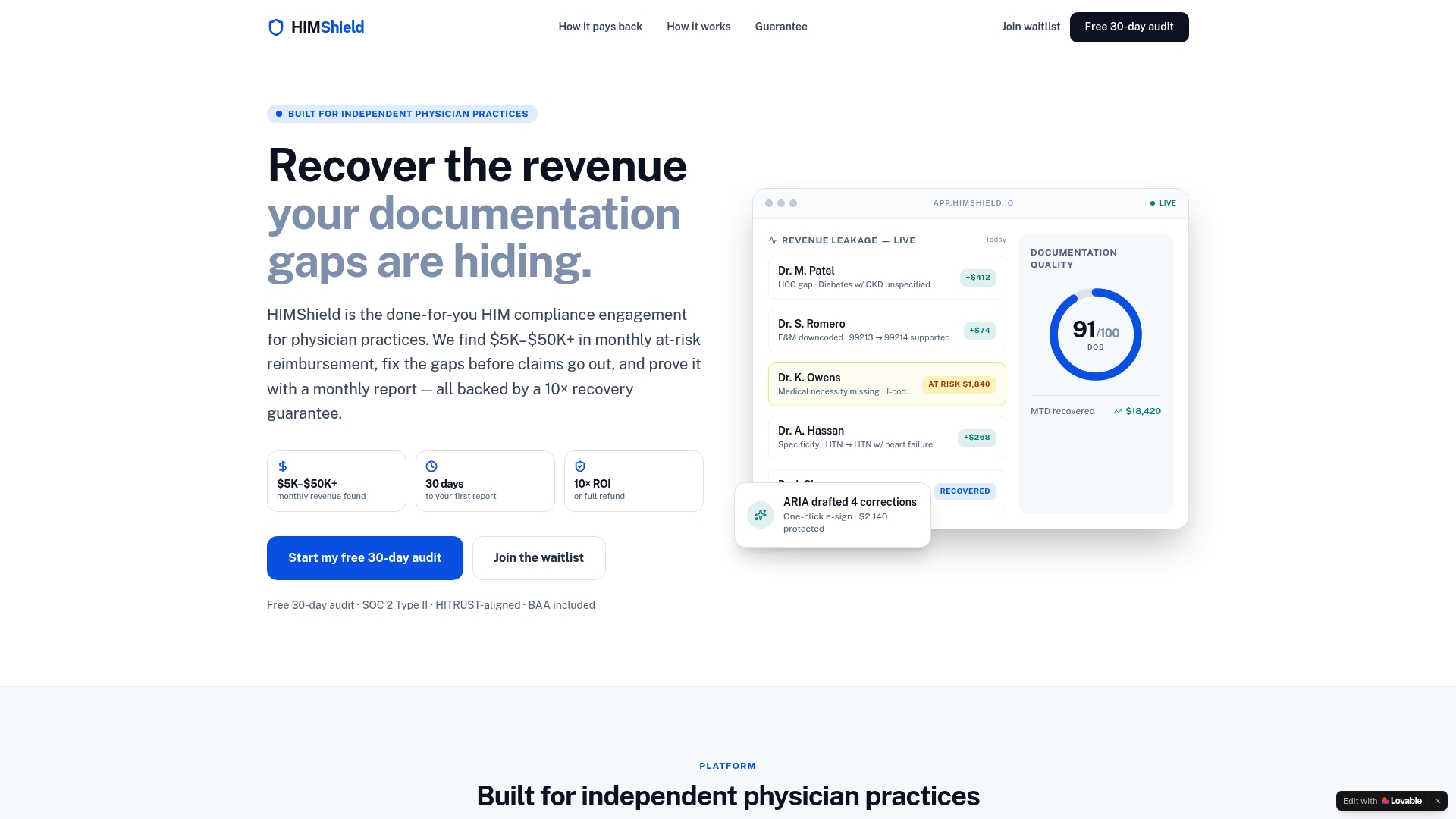
Himshield scans EHR data before claims submission and flags coding, documentation, and charge-capture gaps automatically, cutting the manual audit workload that eats most of a compliance officer's week. It builds per-provider, per-payer Revenue Leakage Reports so the officer isn't starting every quarter from a blank spreadsheet, and it assembles submission-ready evidence bundles when a payer audit does arrive. Practices with multiple payers, high chart volume, or a compliance function run part-time by an office manager tend to benefit most. Himshield's free 30-day audit shows exactly where documentation and charge-capture gaps exist before you commit to anything. Start there to see what your practice is currently leaving on the table.
Sources
- Health Care Directors' Compliance Duties - OIG
- The Role of Medical Coders in Compliance - AAPC Knowledge Center
- Coding Compliance Overview | McGovern Medical School
- CMS: HCPCS General Information
This article is general information, not a substitute for advice from a qualified lawyer. Consult a qualified legal professional about your own circumstances before acting on anything here.